
After the rise of the internet, sports injuries have increased and are slowly becoming common. This is happening because the internet has started a fitness trend in Indian, and now people participate in fitness and sports activities.
All athletes, sports participants, and fitness enthusiasts need immediate medical care from orthopaedic specialists after injury because it helps them avoid permanent damage to their bodies.
Dr. A. Barkat Multispeciality Hospital provides Gaya residents with state-of-the-art sports injury treatment with a combination of advanced diagnostic equipment and individualised rehabilitation plans, and that’s why we are considered the best orthopedic hospital in Gaya.
So, if you are someone who is suffering from a sports injury and looking for a suitable treatment, get in touch with our hospital now.
But before that, you must figure out which type of sports injury you have.
Best Sports Injury Treatments in Gaya
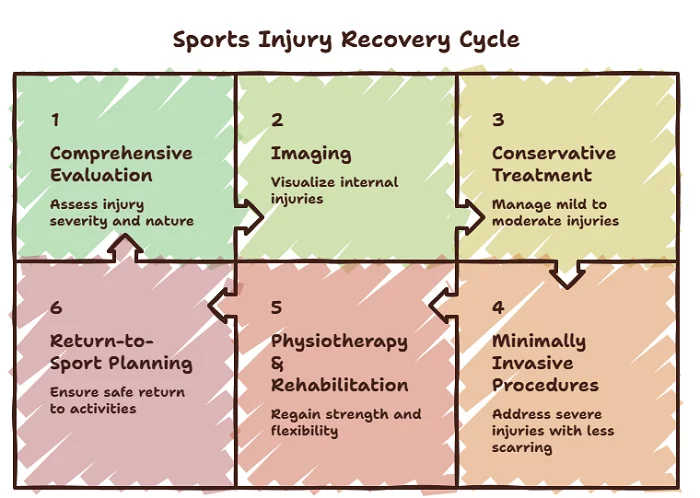
An athletic injury rarely gets better on its own timeline. It needs a real process, one that moves from assessment to imaging to rehab to a return that doesn’t undo all the work. Here’s how that plays out at Dr. A. Barkat Multispeciality Hospital.
Our medical team offers a range of treatment methods, tailored to the severity and nature of your sports injury.
1. Comprehensive Evaluation
Dr. A. Ghufran, our orthopedic sports injuries specialist examines the patient thoroughly. He manually tests the patient’s joint mobility. He also checks the patient’s muscle strength and where exactly the pain is present.
All these give a preliminary diagnosis, for instance, between a muscle tear, a ligament sprain, or an altogether bigger issue, and everything afterward hinges on being right here.
2. Imaging
At times, only a physical examination will be insufficient, especially for a deep injury. X-rays, MRI, or CT imaging will show fractures, soft tissue injuries, or cartilage damage that cannot be detected externally. Imaging will also help rule out other conditions which may look like a plain sprain but are not.
3. Conservative Treatment
For mild to moderate sports injuries, conservative methods prove successful because they eliminate the requirement for surgical procedures.
Our non-surgical methods include the RICE protocol, which serves as our first step for treating injuries because it helps patients rest while applying ice and compression and elevating the affected area to decrease swelling.
We also combine this with suitable pain management drugs to help you manage your pain while your body heals.
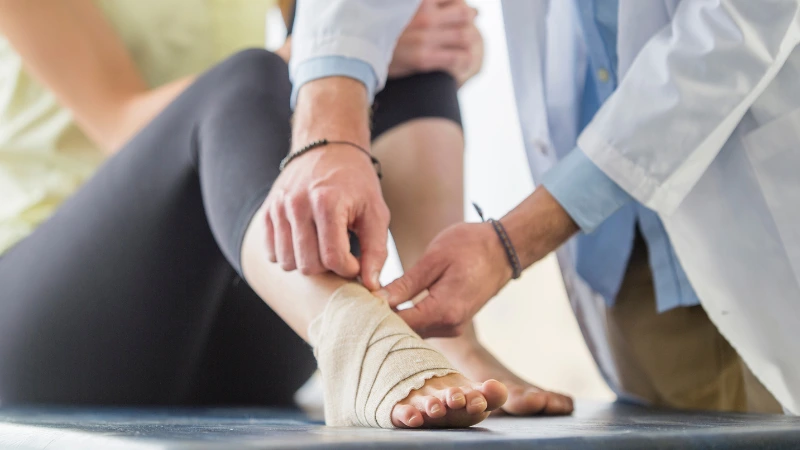
And last but not least, our team provides professional bandaging and bracing services to protect injured areas from additional harm while allowing your body to heal naturally.
4. Minimally Invasive Orthopedic Procedures
Our medical team performs advanced minimally invasive orthopedic surgeries, which lead to shorter recovery times and also reduced post-operative scarring.
We have a surgical team that provides arthroscopic procedures for precise joint operations. Additionally, they also perform advanced ligament repair methods for ACL and MCL reconstruction and tendon repair for damaged tendons that limit movement and strength.
5. Physiotherapy & Rehabilitation
We provide the best physiotherapy in Gaya, which helps patients regain their muscle strength and joint flexibility.
To deliver better and faster results, we use specific post-injury mobility exercises that match each athlete’s sport and fitness level. Our program also includes customised strength and flexibility exercises to provide our give our patients a safe recovery.
NOTE: After a diagnosis is made, the patient is prescribed exercises for rehabilitation to regain strength, flexibility, and balance. Our physical therapists plan these rehabilitation sessions in a manner that fits the patient’s real sport activity. For example, if you are a runner, a football player, or a badminton player, you will be going through training for those specific movements that you need to do in your sport.
6. Return-to-Sport Planning
Going back too soon is how most repeat injuries happen. We test you against your sport’s real demands before clearing you, not just a “does it hurt” check.
🚨 Emergency Orthopedic Care
We have a medical team that delivers complete emergency orthopedic services for urgent situations by treating fractures and bone injuries through proper alignment and stabilisation methods.
Our emergency and trauma care department provides immediate care for severe injuries and accident cases because we believe every life matters.
We combine surgical expertise with contemporary fixation techniques to achieve the best possible results for patient recovery.
READERS NOTE THIS: Certain ligament and cartilage injuries may need minimally invasive procedures from an experienced arthroscopy specialist in Gaya. Getting this diagnosis right early makes everything after it easier.
In all cases, seeking sports injury treatment at the earliest without delay will help achieve the best possible results for patient recovery and mobility.

What are the Most Common Sports Injuries?
The knowledge of sports injury types enables people to identify warning signs that lead them to receive prompt medical care. The sports injuries that occur most frequently in Gaya include:
1. Sprains and strains – They are the overstretching or tearing of ligaments and muscles
2. Muscle tears – This issue results from sudden or repetitive stress, causing tissue damage
3. Ligament injuries – ACL and MCL tears, which are especially common in football and basketball
4. Shoulder dislocation – Very common and often seen in contact sports and weightlifting
5. Tennis elbow – repetitive arm movements leading to tendon inflammation
6. Ankle injuries – Sudden twists and rolls of the ankle, causing ligament damage
7. Stress fractures – Tiny cracks in bones due to overuse
Remember not to ignore the symptoms of these issues, as they may get worse with time and may lead to chronic problems.
That’s why early intervention with proper ligament tear treatment and knee injury treatment ensures better results.
Signs and Symptoms of Sports Injuries
It may happen that you can still go on with a minor workout injury; however, if one or several symptoms occur together, then it really is time to do away with the guesswork and get professional advice.
- When the pain does not subside at all after the rest, it most likely is the first signal, e.g., pain in the joints after playing or feeling a sharp pulling which is most probably a muscle tear.
- Swelling coming on after an injury is the most common sign, and it appears only after the injury and also is the first and the most important indicator of the body’s reaction to internal injury in tissues.
- Bruising appears when blood under the skin starts pooling because of the leakiness of the skin’s vasculature.
- If your knee or ankle feels like it might give way, that’s joint instability and it is often the result of a stretch or tear in the ligament.
- Inability to walk, a diminished range of motion compared to the unaffected side, and muscle weakness in the affected area are all signs that one should pay attention to.
Knowing the signs is one thing. Knowing what they actually mean takes proper testing.
Book Your Consultation for Sports/Ortho Injury Diagnosis >> Consult Now!
Can Sports Injuries Heal Without Surgery?
In most situations, yes. Conservative treatment usually works well for overuse injury, mild sprains, and minor muscle tears; rest, physiotherapy and rehabilitation exercises are usually enough to get you back to normal within just a few days or weeks. The majority of the cases we see are handled with RICE followed by rehabilitative therapy.
However, we may recommend an operation if there is a complete ligament tear, significant cartilage damage or an abrupt injury showing no betterment despite weeks of conservative treatment.
Persistent instability, the locking of a joint or radiological reports pointing towards substantial structural issues – these factors indicate the need for surgery rather than physiotherapy.
Pain shooting down the leg after sports isn’t always a muscle problem either; it can be sciatica or another spinal issue. Read – Sciatica injury treatment in Gaya, which covers the issue in detail.
When Should You See a Sports Injury Specialist?
Every fitness enthusiast must know that sports-related injuries do not always need emergency medical care, but you should seek immediate help when you notice these specific warning signs.
- The pain persists even after resting, and it feels like a sharp sensation
- Your joints and muscles experience ongoing swelling that does not disappear
- The injured area makes it hard to move or stretch your body
- A loud popping or snapping sound occurred when you suffered your injury
- You cannot bear weight on the injured joint or limb
- The affected area shows visible signs of deformity or instability
- Swelling that keeps building instead of going down
– all these signs need attention now, not next week.
At our hospital, we have the best orthopedic doctor in Gaya who performs, early assessment to stop permanent joint harm, muscle weakness, and chronic pain from developing.
Additionally, our medical team at Dr. A. Barkat Multispeciality Hospital delivers fast diagnosis through individualized evidence-based treatment plans that meet the specific requirements of each patient’s needs.
If the same area keeps getting hurt, or symptoms just won’t quit after a few days, that’s your cue to see a sports injury doctor in Gaya instead of trying another home remedy. Don’t wait around for it to get worse before calling a sports injury specialist in Gaya.

Advanced Sports Injury Diagnosis at Our Hospital
In medical science, it is said that, correct identification of medical conditions serves as the essential starting point for successful treatment methods.
That’s why Dr. A. Barkat Multispeciality Hospital provides patients with modern diagnostic equipment, which helps doctors identify both the specific cause and extent of their sports injury through:
- Digital X-ray – It helps in detecting fractures and bone abnormalities
- MRI coordination – We use it for detailed imaging of soft tissues, ligaments, and cartilage
- Ultrasound – This is very helpful for real-time assessment of muscle and tendon injuries
- Comprehensive clinical examination – This examination is performed by experienced orthopedic specialists
The diagnosis process starts with a physical exam, where Dr. A. Ghufran checks for swelling, tenderness, and how the joint moves. If a fracture seems likely, a digital X-ray reveals bone damage.
An MRI shows soft tissue, ligaments, and cartilage in detail, which matters a lot for a running injury or football injury where the damage sits deep. A CT scan comes in for complicated bone injuries that need a 3D view. Then a functional assessment checks how the area performs under real movement, catching problems imaging alone can miss.
NOTE: Lower back pain from sports isn’t always a muscle issue; sometimes it’s a spinal condition, and that distinction matters. If that sounds like you, our back pain specialist in Gaya, Dr. A. Ghufran, can help figure out which one it is.
Our hospital uses advanced diagnostic equipment to generate fast and exact results, which enables our team to develop individualized treatment plans.
Additionally, our sports injury diagnosis services in Gaya provide you with precise medical information, which is used to design a personalised treatment plan.
Guesswork for a diagnosis wastes time you don’t have to spare. Our team pairs hands-on assessment with imaging to figure out exactly what’s going on.
Once we know what’s wrong, rehab becomes the priority. While rehab handles most cases, some genuinely need surgery. Here’s how you tell which is which.
Sports Injury Rehabilitation
Full recovery happens in stages. Skip ahead and you’re likely to end up back where you started, or worse.
It begins with getting the pain and swelling down, then restoring mobility, then rebuilding the muscle strength around the injury. Balance training comes next, fixing the coordination issues that tend to linger after a cricket injury or gym injury.
Sport-specific rehabilitation follows, matching your program to the actual movements your sport asks of you, sprinting, swinging, jumping, whatever it is. Return-to-play decisions only happen once you’ve passed functional tests that prove your body can hold up under real competition, not just light practice.
Talk to Dr. A. Ghufran about a rehab plan built around your sport and your injury. Book an appointment to get started.
Why Choose Dr. A Barkat Multispeciality Hospital for Sports Injury Treatment?
Your recovery path will benefit from selecting the correct medical facility for your treatment. The medical facility at Dr. A. Barkat Multispeciality Hospital provides exceptional results through its combination of medical expertise and patient-focused care.
Our hospital employs orthopedic surgeons who possess advanced sports medicine expertise and knowledge about athletic injury mechanics.
We operate a fully equipped physiotherapy department, which is filled with qualified therapists who help patients through their complete rehabilitation process.
Additionally, we also provide all necessary diagnostic and treatment services within our single facility, which enables smooth care delivery.
Our team focus on developing individualized treatment plans for each patient based on their injury severity and performance targets.
We use quick recovery methods to reduce their time away from activities. So, don’t wait for your joint pain to get worse; book your sports injury consultation today.
>> Visit Dr. A Barkat Multispeciality Hospital in Gaya
FAQs
Following are some of the questions that need to be addressed so that you’re completely informed about the implications of sports injuries and its treatment methods.
1. How to treat a sports injury?
Rest, ice, compression, and elevation first, then get it checked by a specialist.
2. What is the best medicine for sports injuries?
NSAIDs like ibuprofen help with pain and swelling, but check with a doctor first.
3. What are the top 5 sports injuries?
Sprains, muscle tears, ligament injuries, shoulder dislocations, and stress fractures.
4. What is the best treatment for sports injuries?
Correct diagnosis, focused rehab, and minimally invasive surgery only if it’s actually needed.
5. What is the most common sports injury?
Ankle sprains, by a wide margin.
6. Can sports injuries heal without surgery?
Yes, most do, with rest, physiotherapy, and proper rehabilitation.
7. When should I see an orthopedic doctor?
When pain won’t ease, swelling keeps growing, or you can’t put weight on the injured area.
8. Which scan is best for sports injuries?
MRI for soft tissue, X-ray for bones.
9. How long does recovery take?
Anywhere from a couple of weeks for minor injuries to several months if surgery’s involved.
10. Is physiotherapy necessary after a sports injury?
Yes. It’s what actually gets you back to full function, not just pain-free.
11. Can I continue exercising with a sports injury?
Only light activity your doctor approved. Pushing through pain usually backfires.
12. How can I prevent sports injuries?
Warm up properly, strengthen the muscles around vulnerable joints, and don’t spike your training load too fast or suddenly.
Injuries Should Not Stop You from Achieving Your Goals
Sports injuries need immediate specialized medical care to achieve the best possible recovery results.
Early medical intervention helps patients recover faster while protecting them from developing additional problems that would extend their recovery period.
At Dr. A. Barkat Multispeciality Hospital in Gaya, we provide the best sports injury treatment in Gaya. Region folks love visiting our centre because of our compassionate care.
We have top-notch medical care through the combination of state-of-the-art facilities and dedicated patient support.
Don’t ignore your pain and injury; contact us immediately to start your path toward a powerful recovery.
>> Contact Now for Appointment | Call: 922-901-2038 to Schedule Consultation.
Leave a Reply