

Struggling to raise your arm, reach overhead, or comb your hair without wincing? That’s usually frozen shoulder talking. It turns small, automatic movements like dressing, reaching behind your back, tucking in a shirt into something you have to think about and brace for.
It doesn’t show up overnight either; it creeps in over weeks or months, and how far along it is decides what treatment actually makes sense.
Dr. A Ghufran, orthopedic specialist at Dr. A Barkat Multispeciality Hospital, Gaya, can tell you exactly what stage you’re dealing with and what to do about it.
Frozen Shoulder Treatment in Gaya
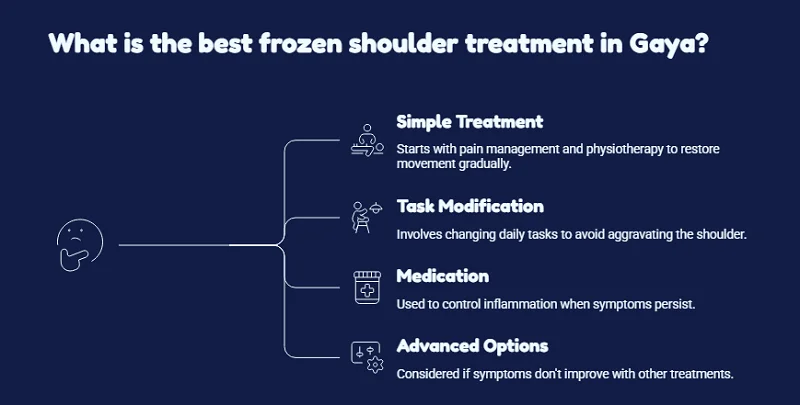
What does treatment actually involve? For most people, frozen shoulder treatment in Gaya starts simple and only escalates if it has to. Pain management, physiotherapy, stretching, slowly getting movement back rather than forcing it is usually the part of treatment protocol.
Sometimes you’ll need to change how you do certain tasks for a while, not stop moving altogether. Medicines come in when inflammation needs controlling, and if symptoms won’t budge, other options get discussed.
None of this is one-size-fits-all; it comes down to your symptoms, how much movement you’ve already lost, how long it’s been going on, and what triggered it. If you’ve been searching for frozen shoulder treatment near me in Gaya, consulting the top ortho surgeon in Gaya early on helps you avoid guesswork and start with a plan suited to your specific stage.
Every shoulder freezes differently. That’s the whole reason a proper evaluation has to come before any treatment plan, not after.

How to Identify Frozen Shoulder?

Here’s the short version: the connective tissue wrapped around your shoulder joint thickens and tightens. Doctors call it adhesive capsulitis. That capsule is what normally lets your arm swing freely in almost any direction but once it stiffens up, movement gets restricted, and honestly, that’s usually what people notice before the pain even registers as a problem.
You’ll hear frozen shoulder condition described in three stages – freezing, frozen, thawing.
- Pain increases and movement gets limited during freezing.
- In the frozen phase, pain can actually ease off a bit, but the shoulder stiffness takes over and the joint feels locked shut.
- Thawing is the slow return of motion.
In practice, these stages of frozen shoulder rarely have clean edges; one often tends to bleed into the other.
So what should make you sit up and pay attention?
Here are the symptoms you should pay attention to:
- Shoulder pain that won’t quit,
- stiffness that keeps getting worse,
- a restricted shoulder movement,
- and pain that’s worse at night – bad enough to wake you up sometimes.
If reaching a shelf or getting a jacket on has turned into a small ordeal, don’t brush it off. It builds slowly, which is exactly why it’s easy to ignore until it isn’t.
What Causes Frozen Shoulder?
Sometimes there’s no obvious reason at all – that’s what doctors call primary or idiopathic frozen shoulder. Other times, you can trace it back: an old shoulder injury, a stretch of immobilization after surgery, or simply not moving that shoulder much for a while.
A few underlying conditions raise the odds too, though having one doesn’t mean it’s a guarantee that you will certainly have frozen shoulder.
Diabetes and thyroid disorders show up repeatedly in clinical literature as frozen shoulder risk factors.
Understanding your own frozen shoulder causes after consultation with an orthopedic doctor, rather than jumping to conclusions, is really where sensible treatment planning starts.
How Is Frozen Shoulder Diagnosed at Dr. A Barkat Multispeciality Hospital?
It starts with a conversation, not a scan. Dr. A Ghufran goes through your history, asks when the stiffness set in, and checks how the shoulder moves — both what you can do yourself and what he can move for you. That contrast between active and passive movement is usually enough to tell a frozen shoulder apart from other problems.
Imaging isn’t automatic. It gets ordered when something doesn’t add up, or to rule out a rotator cuff tear or arthritis hiding behind similar symptoms.
Shoulder stiffness has more than one cause, so skipping straight to treatment without checking is a bit of a gamble. At the multispeciality hospital in Gaya built around this kind of care, the goal is finding what’s actually wrong before deciding what to do about it.
Once that’s settled, treatment can actually begin.
Frozen Shoulder Treatment Options

The treatment modality is based on multiple factors and is only decided after an evaluation with our ortho specialist.
Pain Management
Nothing else works well while every movement hurts, so this usually comes first.
Frozen shoulder treatment medicine typically means anti-inflammatory drugs, and sometimes a corticosteroid injection into the joint, just enough to make stretching and physiotherapy bearable.
Physiotherapy and Exercises
This is where the actual recovery happens. Gentle stretching, range-of-motion work, mobility routines — slowly coaxing the tightened capsule to loosen.
Strength work gets added later, once there’s movement to build on. Frozen shoulder treatment physiotherapy is paced to what the shoulder can handle right then, because pushing too hard too soon usually sets you back, not forward.
Activity Modification
You’re not shutting the arm down completely. You’re adjusting — skipping overhead lifting for a while, maybe — while still keeping the joint moving within what it can tolerate.
Other Treatment Options
If pain management and physiotherapy aren’t cutting it, or the restriction is still significant, other medical interventions come into the conversation.
Dr. A Ghufran works through each case on its own terms; a one-size approach rarely does anyone favors here.
When Is Surgery Required?
Not the first move, but not ruled out either — it depends on how the shoulder’s responding to everything tried so far.
When physiotherapy, medication, and activity changes don’t restore reasonable movement over a fair stretch of time, options like manipulation under anesthesia or arthroscopic capsular release come up.
Both are aimed at physically freeing up that tightened capsule. Whether surgery makes sense comes down to how long symptoms have lasted, how severe they are, and how the patient’s actually responded — never a default step.
Physiotherapy earns its own section here, because almost every treatment plan runs through it.
Can Physiotherapy Help With Frozen Shoulder?
Yes — for a lot of patients, it’s what recovery actually hinges on. Mobility work, done regularly, chips away at stiffness and slowly rebuilds the range of motion that’s been lost. Showing up consistently beats going hard once a week; that’s just how this condition responds.
No two shoulders follow the same script, which is why exercises get tailored rather than handed out from a generic sheet.
And pushing through pain too early tends to backfire rather than speed anything up. Physiotherapy treatment in Gaya can genuinely move the needle on mobility, provided the rehab plan is built around where you actually are in recovery.
When Should You See an Orthopedic Doctor for Frozen Shoulder?

Some signs are worth acting on rather than waiting out. Shoulder pain that’s stuck around for weeks, movement that keeps narrowing, pain that’s messing with your sleep – these matter.
So does a shoulder that’s getting harder to use day to day, symptoms that basic rest hasn’t touched, or stiffness that turned up after an injury or surgery. If pain or stiffness keeps coming back after seeming to settle, that’s worth mentioning too.
Getting checked early separates frozen shoulder from other things that can cause similar pain — rotator cuff issues, arthritis — which need a different game plan entirely. Talking to an orthopedic specialist in Gaya sooner rather than later usually means an easier recovery.
How Long Does Frozen Shoulder Take to Improve?
There’s no fixed number here, and anyone promising one is guessing. It depends on the stage, how severe things are, what caused it, how closely you’re following treatment, and honestly, how your particular body responds.
Some patients see steady progress within a few months. Others take a lot longer. What holds true across the board: it takes time, and sticking with rehab matters more than any single treatment on its own.
How Can You Manage Frozen Shoulder at Home?
Home care supports the treatment plan — it doesn’t replace it. Do the exercises your physiotherapist gave you. Don’t let the shoulder sit completely idle for long stretches; that tends to make things worse, not better.
Keep it moving within what’s comfortable, skip the activities that spike the pain noticeably, and don’t skip follow-ups — that’s how your care team knows whether the plan needs adjusting.
FAQs
1. Can frozen shoulder heal without surgery?
For many patients, yes — frozen shoulder treatment without surgery, mainly physiotherapy and pain management, works well enough. It depends on severity and how you respond.
2. Can you cure frozen shoulder quickly?
Not really. There’s no shortcut to cure frozen shoulder quickly — the capsule needs time to loosen, and rushing it usually backfires.
3. What does frozen shoulder treatment cost?
Depends on how far it’s progressed. Conservative care costs less than cases that need more advanced intervention; your doctor can give you a real number after an evaluation.
4. Is physiotherapy good for frozen shoulder?
Yes, and it’s often the backbone of recovery – structured, consistent frozen shoulder exercises make the real difference over time.
5. How long does frozen shoulder last?
Anywhere from a few months to considerably longer, depending on the stage and how consistently treatment gets followed.
6. Can frozen shoulder come back?
It can, especially in people with underlying conditions like diabetes. Shoulder care doesn’t really stop once symptoms ease.
Seek Care to Ease Pain and Discomfort
Frozen shoulder can genuinely mess with how you move through your day, but it’s not something you have to just live with. A proper assessment, not guesswork, is what makes treatment work.
Whether you’re just noticing stiffness or you’ve been dealing with it for a while, getting it looked at sooner keeps things simpler.
Consult Dr. A Ghufran today for an honest evaluation. You can also book an online appointment at Dr. A Barkat Multispeciality Hospital, Gaya to consult the doctor at a time convenient for you, and start actually moving like yourself again.




Leave a Reply