
Spine problems are rising fast in Gaya and not just in people over 50. Younger adults sitting at desks for hours, workers doing heavy lifting, people who barely move all day; they’re all showing up at spine clinics with the same complaint: back pain that won’t quit.
A slip disc (herniated or prolapsed disc) is one of the most common reasons, along with the numbness, leg weakness, and radiating pain that often come with it.
Most patients recover without surgery if they get to a spine specialist in Gaya early enough. That “early enough” part matters more than most people realise.
What is a Slip Disc?
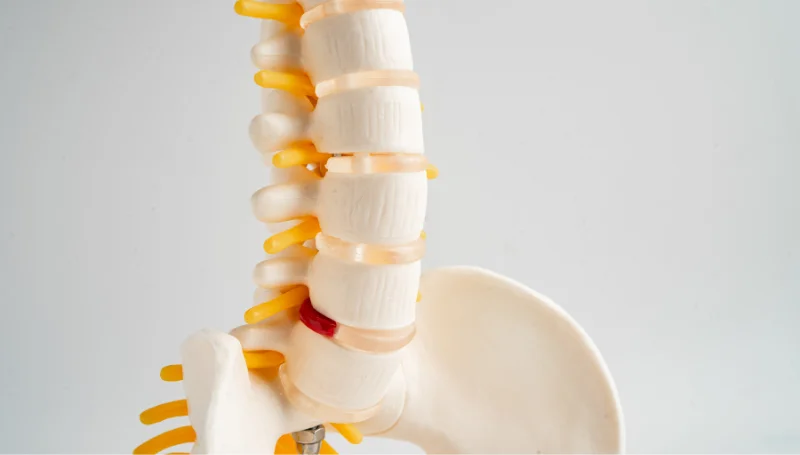
Your spine is a series of stacked bones (vertebrae). The vertebrae are separated by discs that provide cushioning for movement. Each disc has a strong outer ring and a gel-like centre.
If the outer ring weakens or tears, the inner gel will push out. This bulge that protrudes outward is known as a herniated, slipped, or prolapsed disc.
Material that has been displaced will push on the spinal nerves close by. This pressure is the source of the pain, tingling, and weakness not the disc itself breaking, but what it touches.
The lower back (lumbar spine) is the most commonly affected area. But the neck (cervical spine) can also be affected.
Picture a car tyre with a weak sidewall. It doesn’t fail suddenly. It just bulges more and more under pressure until it starts causing problems.
Knowing this helps when you’re trying to make decisions about lumbar disc treatment including whether you actually need to do something now.
Common Symptoms of a Slip Disc
No two people feel the slipped disc symptoms quite the same way. The location of the herniated disc and which nerve it’s pressing on changes what you experience.
Some people have severe lower back pain. Others barely feel it in the back at all; they just notice something wrong in one leg.
Signs worth paying attention to:
- Lower back pain that can be dull, sharp, burning, or some combination
- Pain shooting down one leg, sometimes reaching the foot
- Tingling or numbness in the leg, foot, or toes
- Muscle weakness in one or both legs
- Trouble standing or walking for an extended length of time
- Pain that spikes when you bend forward, cough, or sneeze
A large share of patients who come in for sciatica treatment in Gaya turn out to have a herniated disc pressing on the sciatic nerve.
Sciatica is not a disease; it’s a symptom, and disc herniation is the most common cause of it. One-sided pain that shoots from the lower back through the buttock and down the leg? That’s the pattern.
These symptoms caught early are far easier to treat than the same symptoms six months in.
Causes and Risk Factors
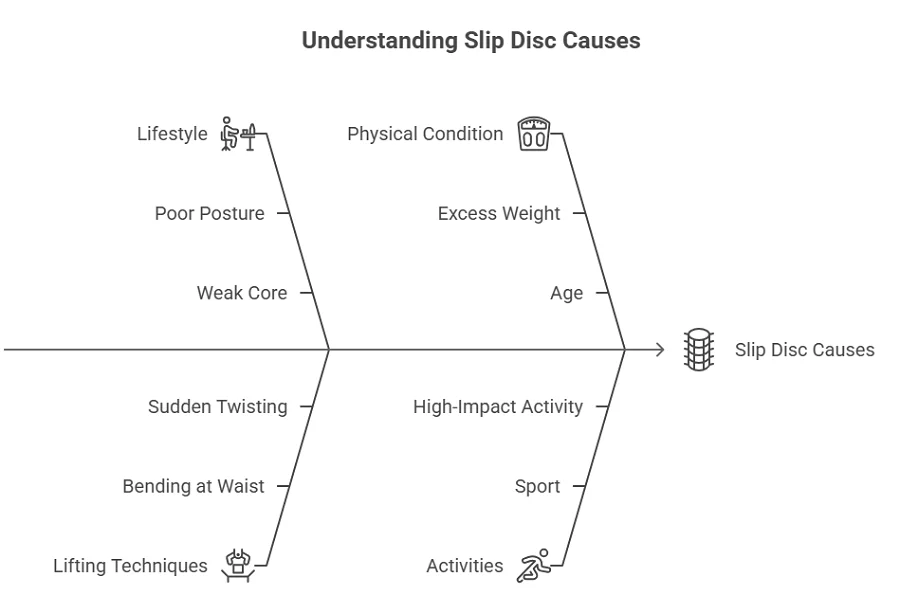
Rarely does a disc herniate out of nowhere. In most cases it’s been quietly weakening for months, sometimes years. One ordinary movement picking something up wrong or an awkward twist finally crosses the line.
The most common contributors include:
- Poor posture: Sitting hunched at a desk for years is the most common reason people develop uneven loading on discs, which causes cumulative damage over time.
- Weak core: When the back and core muscles are not strong enough, it is the discs that absorb most of the stress.
- Lifting wrong: When you bend at your waist and not at your knees to lift a heavy object, that makes the pressure on your discs rise drastically.
- Sudden twisting: An awkward movement that you get used to could even be the reason that a worn-down disc gets herniated.
- Excess weight: Extra body mass will be a constant load on the lumbar spine. Research points out that obesity is an independent risk factor for lumbar disc degeneration.
- Age: Discs lose hydration and elasticity over time. Most people have their first disc changes visible on imaging even without any symptoms by the time they reach 35.
- Sport and high-impact activity: Contact sports and repetitive loading can result in damage to spinal discs.
Note: If a sports injury caused your disc problem, Dr. A. Ghufran’s sports injury treatment in Gaya could be a more targeted recovery approach along with standard spine care.
Knowing your risk factors isn’t about blame. It’s about knowing what to change before things get worse.
Slip Disc Treatment in Gaya
If you’ve been searching for slip disc treatment near me in Gaya, Dr. A Barkat Multispeciality Hospital brings orthopedic care and rehabilitation under one roof.
The orthopedic department is led by Dr. A. Ghufran, an experienced orthopedic surgeon who looks at each patient’s situation individually; there’s no single plan that fits everyone with a disc problem.
Care at the hospital involves:
- Orthopedic consultations to identify which disc is affected and rule out other causes
- Spine evaluations combining clinical examination with appropriate imaging
- Treatment plans built around your specific symptoms, age, lifestyle, and response to care
- Rehabilitation to restore function and reduce chances of the problem returning
- Physiotherapy coordinated by Samar Nausheen, the hospital’s physiotherapist
Whether you need back pain treatment in Gaya or a full recovery programme, the team is set up to see you through each stage.
Consult Dr. A. Ghufran – Book an Appointment at Dr. A Barkat Multispeciality Hospital
Non-Surgical Slip Disc Treatment in Gaya
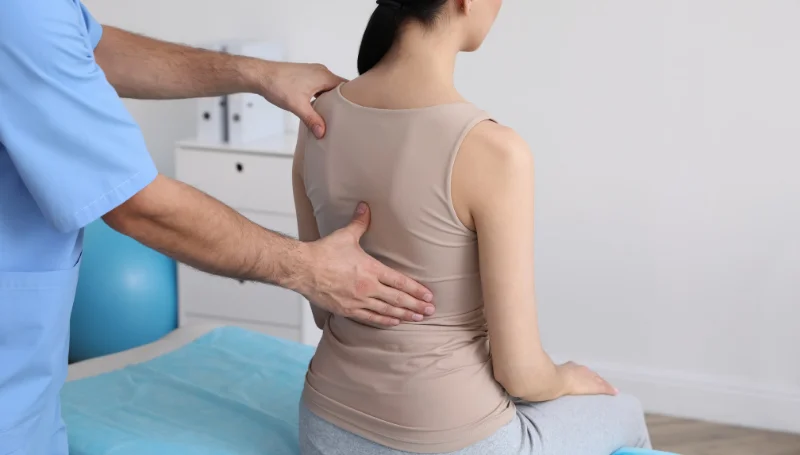
Most people with a herniated disc don’t need surgery. Conservative treatment started early helps handle the majority of cases very well.
1. Medications
Treatment medicine for a slip disc primarily refers to anti-inflammatory drugs (NSAIDs), muscle relaxants, and short-course nerve pain medications such as pregabalin or gabapentin.
These medicines help to decrease the inflammation, soothe the muscle spasms, and directly treat the pain caused by the nerves.
2. Physiotherapy
Doing slip disc treatment physiotherapy is very effective. A well-thought-out programme will not only build the muscles that protect the spine but also reduce the pressure on the injured disc and increase the range of motion.
The physiotherapy services in Gaya at Dr. A Barkat Hospital is very focused on each patient’s disc level and symptom pattern rather than treating everyone with a set of generic exercises.
3. Posture Correction
The way you sit, stand, and even sleep matters a lot, more than what most people think. It is more than just a one-time change; it is a continuous part of the recovery process.
4. Activity Adjustment
You will be shown how to avoid the movements that make your disc problem worse such as bending forward, lifting heavy weights while at the same time keeping yourself fairly active. Total bed rest is not in the plan. The research is quite clear that it slows recovery.
5. Targeted Spine Exercises
McKenzie extensions, pelvic tilts, core stabilisation work; these are the ones that not only help the affected disc get back to its normal state but also keep the rest of the spine healthy and aligned. These are not the same as the usual gym exercises.
6. Heat and Cold
Ice in the acute phase reduces swelling. Heat later in recovery helps relax muscle tension and get blood moving to healing tissue.
Note that slip disc treatment without surgery is achievable for most patients, especially when treatment begins in the first few weeks of symptoms.
When is Surgery Needed?
Surgery is not a starting point. It’s considered by the ortho surgeon in Gaya when conservative treatment has genuinely not worked.
At Dr. A Barkat Multispeciality Hospital, Dr. A. Ghufran will discuss surgical options when:
- There’s severe nerve compression causing unrelenting pain despite 6–12 weeks of conservative care
- The leg becomes progressively weaker and movement control is noticeably affected
- Bladder or bowel control is lost which is cauda equina syndrome, a medical emergency that needs urgent surgical intervention
- Pain continues to significantly limit daily life even after trying multiple treatment approaches
No surgical recommendation is made without thorough evaluation, including MRI imaging and other diagnostic tools required for a thorough examination.
Why Early Treatment Matters?
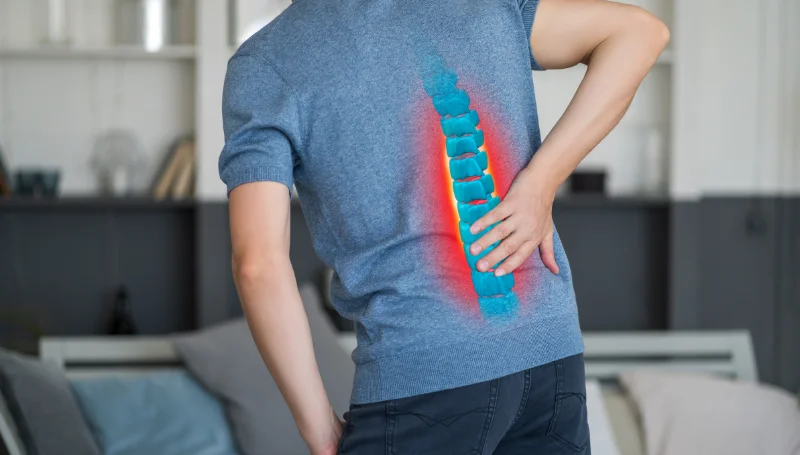
The longer nerve compression continues without treatment, the greater the risk of nerve tissue damage and some of that damage doesn’t fully reverse. That’s the real cost of waiting.
In addition to the underlying structural problem, chronic pain causes sleep disturbances and mood changes, and it can severely reduce one’s work capacity and ability to function normally day after day.
Physiotherapy initiated early for a slip disc not only quickens the healing process but also surgical operation becomes almost unnecessary.
On the other hand, the joint treatment program, orthopedic management along with physiotherapy targets both the structural problem and the recovery of the function.
You are no longer simply handling pain but also enhancing your movement capacity simultaneously strengthening your body.
In fact, initiating the treatment at an earlier stage is generally one of the most significant factors contributing to greater success of the treatment and very rarely is the symptom so severe that treatment will not work entirely.
When Should You See a Doctor for Slip Disc Symptoms?
Back pain is easy to dismiss. But there are signs where waiting is the wrong call.
See a slipped disc doctor in Gaya if:
- Pain doesn’t improve within a few days
- Numbness or tingling in the leg is getting worse over time
- Walking or standing has become genuinely difficult
- Any leg weakness develops, even mild
- Bladder or bowel function changes in any way
Earlier diagnosis means a better chance of avoiding long-term spine complications.
👉 Consult Dr. A. Ghufran – Book Your Appointment Today!
Frequently Asked Questions
Following are some of the commonly asked questions about slip disc issues and the treatment options that you should be aware of.
1. Can a slip disc heal without surgery?
Yes. The majority of cases resolve with physiotherapy, medication, and activity modification over 6–12 weeks.
2. Which doctor treats slip disc in Gaya?
Dr. A. Ghufran, Orthopedic Surgeon at Dr. A Barkat Multispeciality Hospital, Gaya, treats slip disc and related spine conditions.
3. Is physiotherapy effective for slipped disc?
Yes, it’s one of the most evidence-supported treatments available, improving strength, flexibility, and pain outcomes.
4. How long does slip disc recovery take?
Most patients see real improvement within 4-12 weeks of consistent conservative treatment. Full recovery sometimes takes 3-6 months.
5. What activities should be avoided during slip disc treatment?
Heavy lifting, forward bending, sitting for extended periods without lumbar support, high-impact activities, and movements that trigger radiating leg pain.
6. What’s the difference between slip disc and sciatica?
Slip disc is a structural problem: a herniated disc pressing outward. Sciatica is a symptom of nerve pain down the leg that’s often caused by that disc pressing on the sciatic nerve. One causes the other.
Get Rid of Slip Disc Pain Today – Advanced Treatment at the Hospital
Slip disc is indeed very painful, but the majority of people do not even require surgery. This is especially true when correct care is taken, before the patient’s condition worsens.
If you are not sure about the diagnosis, or you have made up your mind that you want to embark on the treatment, getting the consultation scheduled promptly is what has the greatest impact on the final results.
Dr. A. Ghufran and the team for orthopedics and physiotherapy care at Dr. A Barkat Multispeciality Hospital, Civil Lines, Gaya offer the latest research backed and customized spinal care at every stage; from initial consultation to complete rehab.
👉 Book Your Appointment with Dr. A. Ghufran – Orthopedic Surgeon in Gaya 📞 Call: 922-901-2038
Dr. A Barkat Multispeciality Hospital | Civil Lines, Behind Aziza Plaza, Enayat Colony, Gaya


Leave a Reply