
Diarrhea is one of the most frequent causes that brings parents to the pediatrician’s office with their young children.
Diarrheal diseases account for over 443,832 deaths annually among children younger than five years old worldwide — making them the third most prevalent cause of death in children according to the WHO.
The good news is it is completely treatable and even preventable. But first, you need to understand the risks prevalent in Gaya.
There exists a high level of risk for young children in urban areas such as Gaya due to factors including contaminated water sources, seasonal flooding and street vendors selling foods in open food stalls. Thus, there exists a great need for awareness of the risk factors and the treatment strategies that are viable.
As the best hospital in Gaya for pediatric care, our team understands the critical nature of diarrhea in children.
That’s why we have created this detailed guide that provides information for child diarrhea treatment in Gaya that will assist in both treating childhood diarrhea and making decisions regarding when to seek medical attention.
Pediatric Diarrhea Treatment in Gaya
The remedy for diarrhea in babies and young children differs significantly based on the intensity of symptoms that the child is facing.
For instance, when an infant or toddler has a short period of diarrhea, they might only need a little intervention like getting them rehydrated (except infants under 3 months of age who require medical attention right away).
On the other hand, when an infant is experiencing diarrhea for more than a day along with signs of dehydration and/or fever, they have to be taken to the pediatrician.
Consequently, treatment options completely depend on the intensity of symptoms. The following is a brief overview of the levels of severity, which will allow you to understand the possible treatments for pediatric diarrhea more clearly:
1. Mild Cases: Home Care
To treat very mild episodes of diarrhea, home care for child diarrhea is the first line of treatment in most cases. Use Oral Rehydration Solution (ORS), which replaces the electrolytes lost during episodes of diarrhea. Many pharmacies offer low-cost World Health Organization (WHO)-recommended ORS formula.
In addition to replacing electrolytes with ORS, encourage your child to drink plenty of clean water, coconut water or dilute dal water to replace the fluid lost.
Also, give your child a bland diet consisting of rice, bananas, curd and khichri. It is also recommended that you avoid feeding your child any commercially sold juice products and large portions of meals. This way the vast majority of mild cases of diarrhea will see improvement after 2-3 days without additional treatment.
2. Moderate Diarrhea: Consulting with Doctor
If your child’s diarrhea lasts longer than 24 hours and/or is accompanied by symptoms such as fever, blood in their stool or vomit, or your child is visibly weak or unwell, it would be good to contact a pediatrician.
The best pediatrician in Gaya at the hospital will evaluate the degree of dehydration based on a clinical assessment and determine whether pediatric diarrhea medication like zinc supplement (WHO recommends zinc supplement for 10-14 days) is necessary.
Antibiotics should only be used when there is evidence of bacterial infection via stool test. In case of moderate dehydration, IV fluid therapy can begin.
3. Serious Diarrheal Illnesses: Hospital Care
Children who have serious dehydration, persistent vomiting which makes it difficult to eat orally, lethargy/unresponsiveness require immediate medical attention. This is where you need the best emergency hospital in Gaya.
At Dr. A Barkat Multispeciality Hospital, these children are provided IV fluid resuscitation along with close monitoring of hydration level, vital signs and urine production, plus early interventions to avoid potential complications.
Dr. Saba Ekta is a Pediatrician at Dr. A. Barkat Multispeciality Hospital and has experience treating critical illness/conditions in pediatrics and serious dehydration caused due to diarrhea.
Mild vs. Serious Symptoms: Quick Comparison
| Symptom | Mild | Serious — See a Doctor |
| Stool frequency | 3–5 times/day | More than 6–8 times/day |
| Stool appearance | Loose, watery | Bloody or mucus-filled |
| Urine output | Normal | Very low or absent for 6+ hours |
| Behaviour | Active, alert | Drowsy, limp, or crying constantly |
| Eyes | Normal | Sunken eyes |
| Mouth/tongue | Moist | Dry, sticky |
| Vomiting | Occasional | Repeated, unable to keep fluids down |
| Fever | Low grade or none | High fever (above 102°F) |
👉 Consult Dr. Saba Ekta, Consultant Pediatrician in Gaya

🚨 What Should Parents Do Immediately?
The initial 30 – 60 minutes are crucial. The sooner you take action the less the child will lose fluids and the better chance of preventing the condition from getting worse. This is what this all means in terms of real life practice for when a child has diarrhea:
- Start ORS immediately – Use small amounts (sips) frequently as opposed to drinking one big amount at once. For children younger than 2 years old, begin with 50-100ml of ORS after each loose stool.
- Provide hydration to the child – Clean water, rice water and coconut water are acceptable. Try to avoid drinks which contribute to dehydration.
- Breastfeed normally if the child is an infant – Both WHO & UNICEF advocate that normal breastfeeding be continued while the child is experiencing diarrhea. It provides nutritional support and antibodies which assist the child in recovering more quickly.
- Do not give certain foods – Avoid giving the child junk food, sweetened beverages, uncooked veggies, and whole fat milk during diarrhea. These may irritate the gut further.
Do not wait to see a doctor. If your child’s condition does not get better in a day or if they have severe symptoms, take them to the pediatrician’s clinic immediately.
Why Diarrhea Presents Greater Danger to Kids Than To Adults?
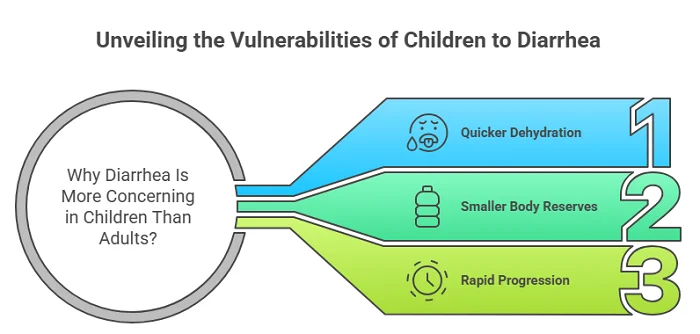
The way that children contract an illness (such as diarrhea) cannot be thought of as being equivalent to their adult counterparts.
This is due to the physiological aspects of a child’s system which results in a quicker escalation of disease and therefore this is why “when is diarrhea dangerous in kids” is a question that every parent needs to know the answer to.
- Quicker Dehydration – A child has a larger body surface area in relation to the body weight. Therefore, a child loses fluid at a much higher rate from sweating and loose stool.
- Smaller body reserves – In addition, a child stores less fluid, electrolyte, and calorie reserves compared to an adult. It takes only a short time for fluid loss to result in serious signs of dehydration in kids symptoms such as: sunken eyes, a dry mouth, decreased responsiveness.
- May Progress Rapidly – Mild diarrhea may rapidly develop into potentially lethal dehydration within just twenty-four hours in infant/young toddler populations. This is particularly true in high temperature/humidity environments such as those during the Gaya summer months.
The aim of giving you this information is not to frighten you. This is intended to help motivate parents to take action earlier, and not later.
Foods to Give and Avoid During Diarrhea
What goes into your child’s stomach during a diarrhea episode can either support recovery or make things worse.
| Give | Avoid |
| Plain rice (soft, well-cooked) | Junk food and fried snacks |
| Banana | Sugary drinks and packaged juices |
| Curd (plain, unsweetened) | Full-fat milk (in large quantities) |
| Khichdi (rice + lentil) | Raw vegetables and salads |
| Coconut water | Carbonated beverages |
| Boiled potato | Spicy or heavily seasoned food |
These are broadly in line with the pediatric diarrhea treatment guidelines recommended by the Indian Academy of Pediatrics (IAP).
When to Visit a Pediatrician in Gaya?

Parents are naturally cautious about seeing a doctor – after all they always hope that the problem will go away.
There are certainly times when it is sensible to take precautions. However, there are times when an immediate visit to a paediatrician is required. As many parents know from experience, a good pediatrician will tell you there are times when a child needs to see a doctor on the same day as their symptoms appear.
1. If Diarrhea Lasts Longer Than 24 hours
Regardless of whether you have used Oral Rehydration Solution (ORS) and tried everything else at home to manage the diarrhea, you will need to bring your child in for an appointment if the symptoms have lasted more than a full day. At this point in time, your child’s diarrhea may require more than just fluid replacement. In fact, treatment for loose motion in children at this stage requires careful guidance.
2. Babies Six Months Old or Younger
Your baby must also be evaluated by a doctor on the same day if she/he has diarrhea and is under 6 months of age. It does not take long for babies to develop severe dehydration which can become life threatening.
3. Signs of Dehydration
While dehydration can occur in anyone who loses excessive amounts of body water (and/or electrolytes), there are specific signs that indicate dehydration in a child. Parents should remember to look for the following classic dehydration symptoms in kids:
- Sunken Eyes
- Dry Mouth
- No Tears while Crying
- Not having a wet diaper for more than 6 Hours
- Extreme Lethargy
Dr. Saba Ekta is a pediatric doctor in Gaya and specialist at Dr. A. Barkat Multispeciality Hospital. The doctor provides consultations for non-emergency patients in her outpatient department and emergency services for critical/urgent patient cases. Do not delay bringing your child in for an evaluation.
✅ Book an Appointment 👉 Best Child Specialist in Gaya Bihar.
Why Early Treatment Matters?
Timing is crucial with diarrhea because the earlier you treat it, the sooner you are likely to see improvement. Here’s what happens if you catch diarrhea early and treat it properly:
- Reduces severe dehydration risk: If you begin using oral rehydration solution as soon as your kid develops symptoms of diarrhea, there is less chance that mild cases will develop into severe ones. For every hour that passes, the window for easily taking care of the case at home narrows.
- Makes hospitalization unlikely: Generally, children get IV fluids and are admitted to hospitals because their parents delayed treating them appropriately with early pediatrician visits and giving them adequate amounts of oral rehydration solutions. The most significant reason for escalation is simply delayed treatment. Early consultation with a pediatrician can prevent complications.
- Results in quicker recovery: Research shows zinc supplements can lower diarrhea duration and decrease its severity by about 18%. This is a meaningful difference for a sick child and a stressed-out parent.
So, the earlier you seek the care of a pediatrician and give your child prescribed medications, the better the chances of faster recovery and less fluid loss.
FAQs
Following are some of the most commonly asked questions by parents about diarrhea in their children. Go through each to get a clearer idea of the condition and what you should do next:
1. What is the best treatment for diarrhea in children?
The best treatment for diarrhea in children is using oral rehydration solution (ORS) that replaces the lost fluids & electrolytes, along with continuing to feed your child bland foods, and giving (only when prescribed) zinc supplements.
2. What is the first line treatment for diarrhea?
Oral Rehydration Solution (ORS) is the first line treatment for diarrhea according to recommendations from the World Health Organization (WHO) and the Indian Academy of Pediatrics.
3. Which syrup is best for diarrhea for a child?
There is no one “best” OTC syrup for treating diarrhea in a child. Any syrup you provide to your child should be done so under a doctor’s advice. Zinc syrup prescribed by a pediatrician is the evidence based method.
4. What is the fastest way to stop diarrhea in children?
The quickest way to eliminate diarrhea in children is early use of oral rehydration solution (ORS), a light diet, continued breastfeeding for infants, and a visit to a pediatrician if symptoms continue beyond 24 hours.
5. Can I give ORS at home?
Yes, ORS is safe and effective, and should be administered at home immediately when you notice the symptoms of diarrhea in your children.
6. What foods should be avoided during diarrhea?
Eliminate junk food, sugar containing beverages, carbonated beverages, raw vegetables, and heavy spice meals until full recovery.
7. Is diarrhea in kids always due to infection?
No, it may occur as a result of food intolerance, antibiotics, and/or other dietary alterations. Infections are the most common reason, however.
8. When should I take my child to a doctor for diarrhea?
Bring your child to see a pediatrician if diarrhea persists longer than 24 hours, if your child is an infant, and/or there are signs of dehydration.
Get Your Child Professional Help Right Away
As long as you start giving your child Oral Rehydration Solution (ORS) early, watch for the warning signs that things may be getting worse, and consult a pediatrician when needed, the chances of recovery are very high.
However, if you notice that your child’s symptoms have not improved or are still worried about what is going on, then it would be best to consult a pediatrician. It’s better to have a medical professional by your side earlier rather than later.
Dr. Saba Ekta, expert pediatric doctor in Gaya and part of the team at Dr. A. Barkat Multispeciality Hospital is available for consultations across multiple OPD slots daily. She will be able to answer your questions regarding any new diarrhea symptoms your child may have developed as well as other ongoing issues regarding your child’s health.
👉 Consult Dr. Saba Ekta | Book Appointment at Dr. A. Barkat Multispeciality Hospital
📞 Call: 922-901-2038 | Civil Lines, Behind Aziza Plaza, Enayat Colony, Gaya, Bihar 823001



Leave a Reply