
It is natural for parents to be concerned about their children’s proper development. Growth is, perhaps, the most straightforward sign of a child’s general good health. Kids mature differently, but there are some signs that may point to a growth problem if detected early.
Spotting these signals early can help a lot. Sometimes it’s difficult to notice growth problems in children at first, but having prior knowledge of what to look for will help you get medical assistance on time.
This blog is a helpful guide for you to understand whether your kid’s development is in line and if you should seek a professional’s guidance.
How to Tell If Your Child Has a Growth Problem? 11 Early Signs
Children show varying patterns in their growth and development. However, some patterns are slightly different and require immediate attention. Listed below are the signs which may indicate your kid has some growth problem and you should definitely consult a doctor.
1. Slow or No Progress in the Growth
A parent should be alert if a child’s height doesn’t become visibly different after a couple of months. Children normally grow around 5-7 centimeters per year during early childhood.
During puberty, growth spurts happen, but if a child’s height remains the same between these growth phases, it is likely to be a problem.
It is a good habit to weigh and measure your children regularly. A dramatically longer period of no growth especially when the child’s brothers, sisters or friends keep on growing is a clear indication that signals the need for a pediatric consultation.
2. Height and Weight Out of Proportion
It is expected that a child’s height and weight change will be proportional to each other. Concern arises when only one measurement changes drastically but not the other one. Weight gain without height or being very tall and underweight might be symptoms of hormonal or metabolic problems.
To catch these kinds of abnormalities at the stage when they are still mild, children should be taken to a pediatrician regularly. Remember proportion between the two parameters also counts and not just their absolute measurements when checking for a child’s healthy development.
3. Signs of Delayed Puberty
In most cases, puberty starts at the age of 8-13 in girls and 9-14 in boys. If the signs don’t show by these upper age limits, then it might be a case of delayed puberty.
The changes in a girl’s or boy’s body eventually leading to the adult stage like breast growth, testicular enlargement, or deeper voice are the focus here.
If these signs are delayed, there might be a problem. The most common reasons for such cases are growth hormone deficiencies and genetic growth disorders.
4. Disproportion Between Sitting Height and Leg Length
Development of the child’s skeletal growth is not always perfect, and this can lead to body disproportions. For example, a child may have a regular torso length but their legs are very short or vice versa.
Such conditions are not always very obvious to the naked eye. They can be the result of skeletal dysplasia, hormonal imbalance, or genetic conditions inhibiting bone growth.
One way of spotting these minor changes is by comparing your child’s body proportions to those of children at the same age.
5. Delayed Shoe Size or Clothing Size Changes
Most parents just measure their kid’s height from time to time without paying much attention to other physical aspects. So, if your kid wears the same size shoes for 18-24 months, you should be concerned.
In the same way, if your child has been wearing the same size clothing for a very long period of time compared to the other kids, it means that his/her growth has stagnated.
Before the kids’ height gets affected and visibly noticed, these daily nuances can tell you a lot. The reason why these indicators are among the most reliable is that during the regular growth phase the kids outgrow their clothes and shoes size quite often.
6. Delayed Tooth Eruption
As you know, growth affects all the body systems since it is a systemic phenomenon. If the permanent teeth erupt way after the normal time frame or the baby teeth fall after a very long time when compared to the other children, the case could be a constitutional growth delay or endocrine problem.
Teeth developmental stages have been well researched and documented. Now, if a child’s development deviates really far from the norm, then the doctor should be consulted immediately as these cases are normally accompanied by other abnormalities in growth.
7. Chronic Fatigue with Poor Linear Growth
When your child becomes fatigued easily, would rather not play, and their height increases in a very slow manner, think about the possibility of some hidden conditions.
Hypothyroidism, growth hormone deficiency, and chronic anemia are among the conditions that could cause such symptoms. The combination of tiredness and slow growth is a bigger problem than just being short.
8. Puberty Timing That Is “Too Early” or “Too Late”
Different types of growth disorders are not only about being too short. Very early puberty can cause the growth plates to close prematurely and thus restrict the final height.
On the other hand, signs of late growth spurt may be a signal of hormonal growth problems. The timing of puberty has a big effect on the final height of a person.
Both premature and delayed puberty should be evaluated to make sure that the person will grow well and to rule out any underlying endocrine disorders.
9. Frequent Abdominal Complaints with Poor Growth
If a person has celiac disease, malabsorption, or inflammatory conditions, he/she may have mild symptoms such as abdominal pain, diarrhea, and bloating.
The above conditions are often underdiagnosed, yet they have a negative impact on the growth velocity. Good digestive health is essential for nutrient absorption.
If your child not growing or gaining weight is combined with persistent abdominal problems, a thorough evaluation including the assessment of the digestive system is indicated.
10. Minimal Height Gain Over 6-12 Months
Normal growth rate depends on age. At the age of 2-6 years, children usually grow up to 5-7 centimeters a year. From six years of age to puberty, it is expected that children will grow about 5 centimeters per year.
Height gain of less than 4 centimeters yearly in children of school age is a small but important red flag that potentially indicates growth issues and thus, requires medical assessment.
11. Delayed Bone Age (Detected Incidentally)
It is possible for an X-ray taken due to an injury to show bone age which is far behind the actual age. This means that the person either has a constitutional delay or an endocrine disorder.
Skeletal maturity and growth potential can be assessed by bone age evaluation. Incidentally, finding this difference gives the diagnostician very useful information, even if the original X-ray was not for growth purposes.
Getting informed about these signs will equip you with the right knowledge to keep track of your child’s growth.

Common Causes Behind Growth Delays

There are different reasons for growth delays. Identifying the underlying cause is essential for appropriate treatment.
1. Nutrition
Lack of iron, proteins, and vitamins has a direct negative impact on growth. Malnutrition, whether it is due to a careless diet, frequent diarrhea in children, or an absorption problem, makes it not possible for children to reach their full growth potential.
Providing a balanced diet is the basic step towards the healthy development of a child.
2. Hormonal Issues
Most of the time, growth hormone deficiency and thyroid diseases will be the most common growth disorders. Such conditions interfere with the body’s inherent growth functionality.
Once a hormonal imbalance is detected early, appropriate treatment is usually very effective in restoring normal hormone levels. In most instances, hormonal imbalances are corrected successfully.
3. Chronic Illnesses
When kidney disease, heart conditions, or digestive disorders are present, the body loses energy and nutrients that are normally used for growth.
It is, therefore, very important to continually manage the condition so as to have improved growth outcomes. Comprehensive medical care focuses both on the symptoms and the condition causing the symptoms.
4. Genetic Factors
An inherited disorder or condition can make normal growth difficult and the growth pattern gets affected drastically. So, family history may be a good indication of what is to come.
Genetic evaluation is a valuable tool for diagnosis and treatment of some genetic conditions causing a short stature condition.
5. Lesser-Known Causes
It is possible for growth to be subtly impaired by chronic stress, poor sleep quality, and excessive screen time. The above-mentioned lifestyle choices impact hormone production and overall wellness.
Addressing them supports better growth outcomes alongside medical interventions. Knowing potential causes helps you work with healthcare providers effectively. Let’s explore how you can monitor your child’s growth at home.
Normal Growth Patterns and At-Home Observations Parents Can Track
Understanding normal growth helps you identify minor variations and distinguish them from concerning patterns. It is important to note that children’s growth rate varies, they can experience rapid-growth periods alternating with slower phases.
Standardized growth charts by WHO or CDC are a good benchmark to evaluate your child’s measurements. These charts delineate the usual ranges according to age and sex. Your child does not have to follow the 50th percentile exactly.
What is more important is the child’s measurement consistency rather than the absolute position. A child who is consistently tracking the 25th percentile is most probably fine, whereas a child whose percentile ranks change drastically may require further attention.
Tips for Measuring Height and Weight
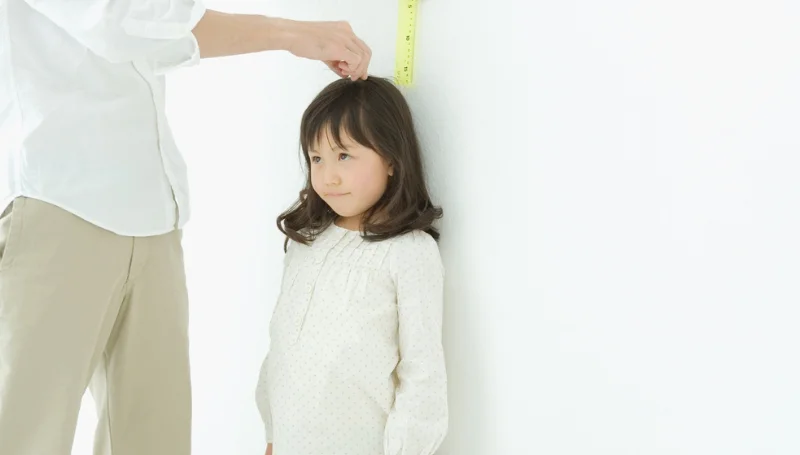
Take measurements at the same time of a day, morning is best before breakfast. You may use a flat wall and remove their shoes to get the most accurate height measurement.
Keeping a Growth Diary
Write down the measurements every month and include the exact dates. Also, add notes about shoe sizes, changes in clothes, and the achievement of different developmental milestones to have a fully detailed record over time.
Use Visual Examples
Put the measurement points on the illustratable growth charts. Visual patterns help to understand the data much better than the numbers alone, thus making it clearer when there is a problem.
Home assessments can give a considerable amount of information, but a trained doctor’s examination is indispensable if there are any doubts.
When to See a Pediatrician?
Not every growth difference between children needs medical intervention. It is perfectly normal if your child is slightly different than his or her peers.
However, some situations definitely call for a professional opinion. For example, signs of growth spurt in teenagers can vary, but the absence of puberty signs, which are normally noticed within the early adolescence, if clearly lacking by 14-15 years, should raise concern.
In case your little one is showing several worrying signs, it is necessary to get help without any delay. Quite a few growth problems can be totally resolved if discovered early.
If you live in Gaya, you can contact Dr. Saba Ekta-MBBS, MD (Paediatrics), a consultant paediatrician and neonatologist, who is widely known as the best pediatrician specialist in Gaya for comprehensive growth and development management.
Psychological or Social Withdrawal Due to Height Difference
While not used to make diagnosis, symptoms such as children stopping to join in sports, cutting themselves off socially because of social embarrassment, and having low self-confidence due to a short stature should encourage the parents to seek a professional opinion.
Besides physical health, emotional health is also very important. Behaviour simply because of psychological problems can be the first manifestation of child growth disorders symptoms.
Thus, these behavioural changes are worth considering as an important indication for consultation with your pediatrician.
Signs for Seeking Medical Care
Consider medical evaluation when you notice:
- Height that is continuously below the 3rd percentile on growth charts
- Growth velocity below 4 centimeters per year after 6 years of age
- Crossing two major percentile lines downward on growth charts
- Disproportionate body parts or skeletal abnormalities
- Puberty still not started at 13 years (girls) or 14 years (boys)
- Chronic fatigue along with poor growth
Recommended Check-Up Frequency
Well-child visits should be scheduled once a year at a minimum. In cases where concerns about growth exist, screening every three months can be a way to check that the progress is going in the right direction.
Frequent visits during the puberty period also allow immediate intervention if it is needed. Your pediatrician will be the one to decide when you should come the next time for monitoring based on the individual needs.
The evaluation routinely includes laboratory assays for hormones, thyroid, and nutritional indicators. Hormone analysis is made to see whether there is a deficiency or imbalance.
Bone age X-rays, an imaging technique, is used to reveal one’s growth potential. All these investigations give detailed data that help the doctor to make a plan for your child that is specifically tailored to the child’s needs and will be the most effective.
Questions to Ask Your Pediatrician About Child Growth
Note down the following questions to ask your doctor when you go:
- Which percentile does my child’s growth correspond to?
- Have they been growing faster or slower recently? Has their growth velocity changed recently?
- What tests/investigations would be appropriate?
- Could it just be a phase or is there a need for medical treatment?
- What is the estimated adult height of my child?
- How long should we wait for the next measurement?
It is important to keep in mind that growth problems are usually not difficult to treat if they are caught early. A high percentage of conditions can be successfully treated if the patient has not completed puberty yet.
Parents should not hesitate to express their worries. Our pediatricians enjoy working with parents who are proactive.
By acting on warning signs early, you are making sure that the right care for your child is given without delay.
Schedule a Pediatric Growth Check Today!
Early detection helps a lot in making the treatment more effective and timely. Even though every child is unique in terms of development, being aware of the signs of problems allows you to take action when necessary.
Keeping an eye on your child’s growth at home, being aware of normal changes, and spotting warning signs gives you the power to support your child’s health. Never ignore persistent doubts, it is your instinct that you should rely on.
If there are several indications, do not hesitate to make an appointment at the best hospital in Gaya for a consultation on growth issues with our pediatrician.
If you are living in Gaya, you can rely on Dr. A Barkat Multispeciality Hospital to provide not only thorough examination but also treatments for abnormal growth patterns and growth disorders.










Leave a Reply